

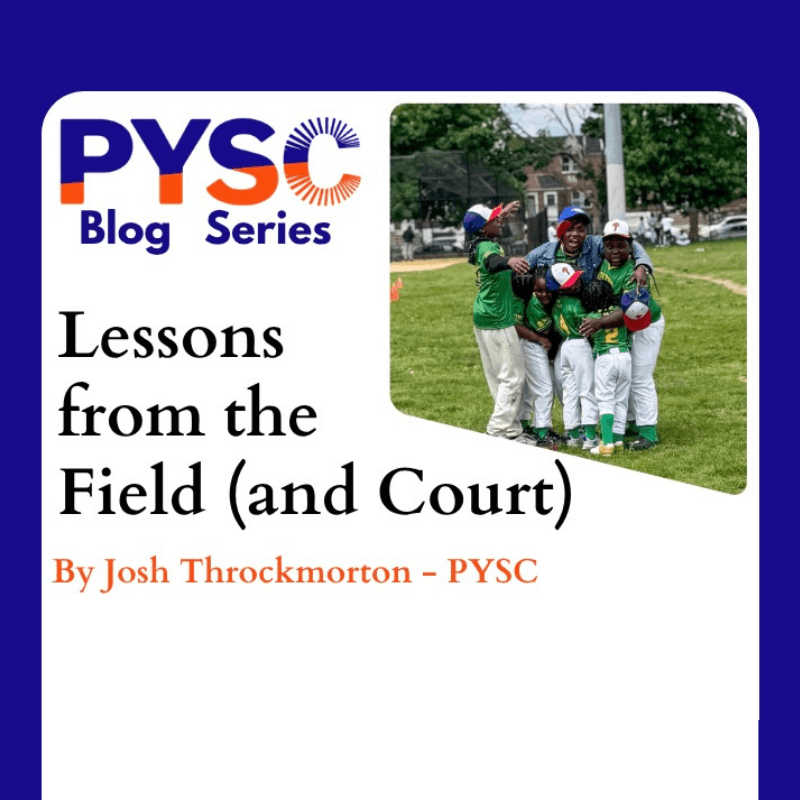
Lessons from the Field (and Court)
By Josh Throckmorton
Over the past several months, PYSC has partnered with Philadelphia Parks & Recreation to design and test models for accessible recreational sports programming across the city. These efforts—most recently the Octavius Catto Youth Baseball League and Red Ball Tennis—have united institutional partners (the Philadelphia Phillies and U.S. Tennis Association), PYSC members (The On Deck Circle, Anderson Monarchs, Mt. Airy Baseball, and Legacy Tennis), and city employees around a common goal: to learn how to work together to provide young Philadelphians and their families with safe, inclusive, and engaging opportunities to build positive, meaningful relationships through sports.
With spring seasons now behind us and planning for fall soccer programming in full swing, we figured now’s the time to step back and reflect on what we’ve learned so far. Here are our big takeaways:
1) Families want their kids to try new activities but are sometimes wary of the “intensity” of the youth sports.
This spring, 75% of Catto League ballplayers and 88% of Red Ball Tennis program participants tried their sport for the first time. Feedback from parents and guardians registering their kids was consistent: these opportunities were appealing because they were local (at their neighborhood rec centers), affordable (pay-what-you-can, up to $40), and didn’t require a huge time commitment (1-3 days per week of no more than 75 minutes at the field or court). One Red Ball Tennis parent echoed the sentiments of others who responded to our post-season surveys when they said, “Since my child is young and doesn't yet know what he likes, I liked that the season was relatively short, financially accessible, and helped teach him the fundamentals.”
2) Philadelphia Parks & Rec staff want to lead programming and will do a great job when given the resources to do so.
Similar to the young athletes, the Philadelphia Parks & Rec staff members who raised their hands to participate in these programs were new to their sports, too: 70% of Catto League coaches and 89% of Red Ball Tennis coaches reported that they had never coached—or even played—their sport before the season. To make coaching accessible, PYSC and our strategic partners at Parks & Rec, the Philadelphia Phillies, and the U.S. Tennis Association designed a coach development process to intentionally onboard coaches to their sport and empower them to take ownership of their programs. Together, we provided equipment and apparel, administrative processes, communication templates, in-person and online training, practice curriculum, and feedback to guide their learning. One Catto League coach wrote at the end of the season: “I honestly didn’t think I could coach, although it’s something I always wanted to do…I loved what this coaching experience has done for me as a whole. It even gave me more confidence at bringing different programs into the recreation center.”
Surveys collected from parents and guardians suggest the coach development model was a smashing success (tennis pun intended). 100% of Catto League families and 100% of Red Ball Tennis families who responded to mid- and post-season feedback forms reported that their child had a positive experience with their coach – and a combined 96% of families said they’d register for another program led by their Parks & Rec coaches.
3) Philly is proud of its communities and loves showing it.
While we know Philadelphians love showing their pride in their sports teams, we admittedly didn’t anticipate just how deeply connected to their children’s teams the Catto League and Red Ball Tennis families would be. Across both programs, we saw coaches and families of young athletes print custom t-shirts and hats celebrating their rec center; design team logos and print stickers for their kids; and bring balloons in their team’s colors to community play days. This reinforced the importance of providing center-specific team colors and clothing to kids and their families, a lesson we’ll carry forward by allocating more resources towards apparel in the upcoming soccer season.
4) It’s not that expensive to fund affordable, well-resourced entry-level youth sports programming.
While we acknowledge that both the Catto League and Red Ball Tennis program received free access to field and court space, web hosting services, participant registration software, t-shirts, training curriculum, and dedicated staff time from our partners, big picture, neither program was particularly expensive to run. To train nearly 40 Philadelphia Parks & Recreation coaches to provide more than 250 young Philadelphians at 15 rec centers with 8+ weeks of entry-level sports programming, PYSC spent less than $50,000 on equipment, apparel, training contracts, child safety measures, data collection services, program management technology, and end-of-season program celebrations. If local proponents of youth sports want to fund thoughtfully planned, community-based programming, they can…without draining their personal, corporate, or government bank account.
These lessons are already shaping how PYSC, Philadelphia Parks & Recreation, and our partners work together to create new opportunities for Philly’s youth to try sports in their communities across the city. As we continue this work, we’ll keep listening, learning, and building models that make youth sports more accessible, welcoming, and sustainable for every Philadelphia neighborhood.


From Childhood Dreams to World Cup Reality: How Soccer Shapes Our Community
By Melissa Piccoli
There's a photo somewhere in my mom's house that perfectly captures the beautiful chaos of youth soccer: a dozen kids in oversized jerseys chasing a ball across the field, no strategy, no positions, just pure joy. I'm in there somewhere, probably with grass stains on my knees and the biggest smile on my face. Back then, I had no idea I was experiencing something that would shape not just my childhood, but eventually my career.
I don't play soccer anymore. In my adult life, my relationship with the game has mostly been cheering on the U.S. Women's National Team. But there was a time when soccer was everything to me, and looking back now, I realize just how deeply it shaped my childhood in ways I didn't fully appreciate until much later.
As a kid, soccer quickly became the center of my universe. It was how I made new friends, what I looked forward to after school, and what gave structure to my weekends. But it was more than just a sport. During some of the more difficult moments in my life, soccer wasn't just an outlet. It was a support system that taught me about teamwork, resilience, and the value of showing up and working hard.
Fast forward to today, and I find myself reconnected with that beautiful game in the most incredible way. Two years ago, I joined Philadelphia Soccer 2026 (PS2026), the local host committee tasked with planning and delivering FIFA World Cup 26™ right here in Philadelphia. Suddenly, that little kid chasing the ball had a front row seat to helping bring the world's biggest sporting event home.
In 2026, Philadelphia will host six World Cup matches at Lincoln Financial Field and the FIFA Fan Festival™ at Lemon Hill in Fairmount Park, a free celebration where families can come together to experience the magic of the tournament. But here's what excites me most. This isn't just about 40 days of incredible soccer. It's about using this global spotlight to amplify the amazing work already happening in our youth sports community.
Being part of PS2026 has shown me firsthand how powerful our soccer community is. I've watched organizations across Pennsylvania, including PYSC, use the beautiful game as a tool to enhance young people's wellbeing, build bridges across different backgrounds, and create opportunities where none existed before. The World Cup gives us a megaphone to celebrate and expand that impact.
Through our partnership with the U.S. Soccer Foundation, we're committed to creating lasting change across the Commonwealth. We're building safe places to play, implementing programs like Coach Mentor Training and Soccer for Success, and establishing a legacy endowment for Eastern Pennsylvania Youth Soccer and PA West Soccer that will honor the World Cup's spirit long after the final whistle.
That chaotic photo from my childhood represents something beautiful. It captures the moment when a simple game becomes a gateway to friendship, growth, and community. In 2026, when kids across our Commonwealth watch the world's best players take the field, some of them will have that same spark ignited.
The countdown to 2026 has begun, and we are ready to show the world what Philadelphia soccer is all about: passion, community, and the belief that every kid deserves a chance to chase their dreams across the field.

The Power of Story: How Youth Sports Narratives Drive Progress in Philadelphia
By Steven Giannino-Malatesta, Ph.D
In every neighborhood gym, rec center, and playground across Philadelphia, young people are building confidence, discipline, friendships, and futures. These moments, often simple and fleeting, are the heartbeat of youth sports. But too often, the story ends there. The impact stays local. The data stays in spreadsheets. And the broader world moves on.
That’s where narrative and strategic communication come in. For youth sports organizations, storytelling is not just about visibility. It is about making the invisible visible. It is about turning attendance numbers and program outcomes into portraits of transformation, resilience, and real community impact. In a city like Philadelphia, where hundreds of grassroots organizations are doing extraordinary work with limited resources, narrative becomes a vital tool. Not only to celebrate what is happening, but to help it grow.
Numbers matter. Funders want metrics. Government officials need data to inform policy. But numbers alone do not move hearts. Stories do. When we share the story of a 12-year-old girl who found her voice through basketball, or a neighborhood coach who became a father figure to dozens of kids, we are not just talking about programs. We are showing purpose. We are building connections.
Narrative gives data context. Instead of simply saying “92% of youth felt more confident after participating in summer sports programming,” we can show what that confidence actually looks like—raising a hand in class, standing up to a bully, trying out for a team. These personal stories turn abstract stats into real, relatable change. They bring progress to life.
When used intentionally, storytelling creates a ripple effect that can build momentum across every area of an organization’s work. For families and communities, stories build trust. Parents are more likely to sign their children up for a program when they see kids who look like theirs thriving. Neighbors are more likely to volunteer, attend events, or become advocates when they feel the human impact of your work. The story is not “we offer free soccer.” It is “this soccer team helped a group of refugee youth feel at home in South Philly.”
For funders and donors, stories bring outcomes to life. They elevate the value of your work and show what spreadsheets cannot—your organization’s cultural competency, relationships, and deep local knowledge. They make it easier for grant panels to say yes. For policymakers, storytelling shows how decisions made in offices affect lives on the ground. A $5,000 grant becomes a renovated basketball court. That court becomes a safe hub for 200 kids after school. A trauma-informed coaching training leads to fewer fights, more trust, and real change. These are not just stories. They are evidence that public investment matters.
Storytelling does not have to be complicated. But it should be consistent. Collecting quotes, photos, and testimonials from youth, coaches, and families should be part of your program rhythm, not a one-time campaign. Youth voices should be front and center. Their stories are powerful, and their words reflect the truth and diversity of our city. Connect these stories to your outcomes and your mission. Show not just what happened, but why it matters. Share them widely—on your website, in newsletters, on social media, in grants, and in meetings. And make sure you're telling stories from across the city, from Kensington to Kingsessing, Fairhill to Fox Chase. Every neighborhood has something to say.
Youth sports are more than games. They are one of Philadelphia’s most powerful tools for building equity, belonging, health, and opportunity. But to unlock that potential, we must do more than run strong programs. We must tell the story of their impact, clearly and consistently. Because when we tell those stories, we grow our reach. We grow our influence. We help people see what is possible when every young person has access to a safe, supported space to grow.
We turn moments into movements. And in a city built on grit, passion, and heart, that might just be the most important story we can tell.
Let’s make sure it is heard.

Coaching for Change: Youth Sports as a Frontline Strategy in Philadelphia
By Dontae Privette
Philadelphia is facing a defining moment. Despite our vibrant neighborhoods and strong community pride, the city continues to grapple with one of the highest rates of youth violence in the country. At the same time, access to quality youth sports remains deeply unequal.
This combination of high violence and limited access to protective, structured activities creates a serious risk to public safety, youth development, and long-term community well-being. But what if the solution is already in our neighborhoods?
Only 20 percent of Philadelphia’s children are meeting the CDC’s physical activity guidelines. Just over half of youth nationwide participate in organized sports, and even fewer have access to programs that are trauma-informed, culturally responsive, and accessible across lines of race, gender, income, and ability. These gaps persist despite decades of research showing that youth sports lead to higher graduation rates, improved mental health, and better long-term economic outcomes.
Mayor Parker’s administration has committed more than $3 million to youth sports through the One Philly Budget. It’s a meaningful investment, and one that reflects a broader shift in public sentiment. Pew’s recent polling shows that 63 percent of Philadelphians support the mayor’s public safety strategy, and nearly 60 percent believe the city is on the right track—the highest level of optimism since before the pandemic. But even with increased investment, the city lacks the infrastructure, coordination, and coaching standards to make the most of this opportunity. Without a unifying strategy, siloed programs and under-resourced providers will continue to struggle, leaving thousands of young people without the support they need.
That’s where PYSC comes in. With support from the Office of Public Safety, we are embedding youth sports directly into the city’s violence prevention strategy. We are building a trained, resilient workforce of youth coaches and giving them the tools to collaborate across schools, rec centers, and community organizations. We’re not just offering programs—we’re creating anchors in neighborhoods across the city where kids can feel safe, seen, and supported.
Our approach draws inspiration from models like the Laureus Foundation’s work in Chicago, but it is tailored to Philadelphia’s unique needs and assets. We work with strategic partners like Philadelphia Parks and Recreation, academic researchers, and grassroots organizations to make sure that every effort is evidence-based and community-driven. We know that coaches are the number one reason kids stay in or leave a program, so we focus our resources where they matter most.
This work also brings long-overdue attention to systemic barriers that have gone unaddressed for too long. Many of our neighborhoods lack safe fields or courts. Families don’t always have access to transportation. Funding is fragmented. And too often, girls, Black and Brown youth, and children with disabilities are left out entirely. We need a citywide youth sports system that integrates strong coaching and officiating pipelines, real-time data, community voice, and aligned city policy.
At PYSC, we believe youth sports are not an extracurricular activity. They are a frontline strategy for public safety, economic mobility, and generational health. It is time to stop piloting ideas and start building blueprints. The opportunity to get this right is right in front of us, and the cost of inaction is far too high.
In the coming months, we’ll be working with our partners across Philadelphia to turn this momentum into a bold, citywide action plan. The question is no longer why youth sports matter. It’s how quickly we can scale what works.

More Than A Game: The Power of Our Youth Sports Community
By Dominique “Dom” Curry
At the Philadelphia Youth Sports Collaborative (PYSC), we frequently emphasize that youth sports are more than just a game. It is a movement. A community. A lifeline. And at the core of this movement are our members—more than 100 organizations from across the city that work every day to support Philadelphia's youngsters.
As Director of Member Engagement, I have the unique opportunity to see the power of our network firsthand. From tennis fields to basketball gyms, baseball diamonds to squash courts, PYSC members are establishing safe spaces for young people to study, grow, and thrive.
Every organization in our network offers something unique: mentorship, structure, opportunity, and love. Whether it's a coach who devotes additional time to mentoring after practice or a volunteer who ensures a youngster gets transportation to their first game, these ordinary events change lives and shape futures.
This spring, at our PYSC Networking Night at SPIN, I saw members reconnect, collaborate, and celebrate work that is frequently done discreetly behind the scenes. These moments of connection remind us that we are stronger together, and that our combined impact goes well beyond the scoreboard.
Thank you to every member of the PYSC. Thank you for your perseverance, inventiveness, and everlasting confidence in the potential of sports to foster community. Thank you for being mentors, champions, and change-makers. Your job benefits not only the children you serve, but the entire community.
As we look ahead, PYSC remains committed to raising your voices, enhancing your work, and standing beside you as we advocate for justice and opportunity for all young people in Philadelphia.
We invest in youth because we believe it will benefit the future.

In Philly, Sports Belongs to Everyone: Why Youth Sports Shouldn’t Be a Luxury
By Shannon Gunby, Executive Director, The On Deck Circle
Philadelphia is undeniably a sports city. From the roar of the crowd at Citizens Bank Park to the sea of green on game day for the Eagles, sports pulse through our streets, our neighborhoods, and our culture. But for too many young people in Philly, the chance to play sports doesn’t come as easily as buying a ticket or joining a neighborhood team. While our city is rich in sports tradition, there are still deep equity gaps when it comes to youth access, especially in under-resourced communities.
At The On Deck Circle, we believe every child should have the opportunity to play, grow, and thrive through sport, no matter their zip code, family income, or prior experience. And we’re not just talking about competition. We’re talking about connection, character-building, and the simple joy of being part of something bigger than yourself. Unfortunately, for many families in Philadelphia, barriers like lack of equipment, limited field space, unaffordable league fees, and the absence of trained coaches make access to sports feel out of reach.
Across much of the country, youth sports have shifted into a pay-to-play system. Philly is no exception. This setup leaves many Black and Brown youth, along with families living paycheck to paycheck, without a path into meaningful athletic experiences. The impact stretches far beyond the field. Kids miss out on chances to build confidence, learn teamwork, and develop lifelong healthy habits.
That’s where The On Deck Circle comes in. We are committed to breaking down these barriers by bringing free, inclusive, and high-energy Quickball programs to neighborhoods across the city. We supply all the equipment, train local coaches and volunteers, and work with rec centers, schools, and community groups to make it easy for kids to show up and play.
Our Quickball model makes baseball more engaging, more inclusive, and more fun. It focuses on teamwork, energy, and accessibility. We’ve seen what happens when a kid picks up a bat and ball for the first time: their eyes light up, they find confidence, and they feel like they belong. We’ve also seen how programs like these can help reclaim public spaces, support working families, and build communities where all kids feel seen and celebrated.
But we cannot do this alone. Closing the equity gap in youth sports takes more than a one-time investment. It requires real commitment—to the coaches, the families, the community partners, and the kids themselves. It means listening, showing up, and doing the work side by side.
Philly has the heart of a champion. Let’s make sure we’re putting that heart to work where it matters most: on the playgrounds, blacktops, and ballfields where kids are still waiting for their chance to play. At The On Deck Circle, we’re not just coaching games. We’re opening doors, creating connections, and building something real. One swing at a time.